MOTS-C: what the literature covers

MOTS-c is a short peptide encoded in mitochondrial DNA rather than the nuclear genome, which is what makes it interesting to researchers. This article summarises what it is, what the published literature uses it to study, and what to check on a research lot. It describes laboratory research only.
What MOTS-c is
The name stands for mitochondrial open reading frame of the 12S rRNA-c. Most of the proteins that work inside mitochondria are encoded in the cell's nucleus. The mitochondrial genome is small, and for a long time it was thought to encode only a short, well-known list of proteins, along with the RNAs mitochondria need to make them. Mitochondrial-derived peptides are a small group of short peptides encoded by short open reading frames inside that genome. MOTS-c is one of them, with its open reading frame located within the gene for the mitochondrial 12S ribosomal RNA. It was first described in 2015.
The molecule
| Length | 16 amino acids |
|---|---|
| Sequence | MRWQEMGYIFYPRKLR |
| Molecular formula | C101H152N28O22S2 |
| Molecular weight | 2174.6 g/mol |
| CAS number | 1627580-64-6 |
A few features of the sequence matter at the bench:
- Two methionines, at positions 1 and 6, which account for the two sulfur atoms in the formula. Methionine is one of the residues most prone to oxidation, and each oxidised methionine adds about 16 to the mass. That is one reason identity by mass spectrometry is useful on a MOTS-c lot: an oxidised form shows up as a separate, heavier mass.
- A tryptophan at position 3, another residue that can be sensitive to oxidation and to light.
- Several basic residues: three arginines and a lysine, towards the C-terminal end of the chain, which give the peptide a net positive charge at neutral pH.

What the literature uses it to study
In published cell and animal studies, MOTS-c is used to investigate a set of related questions:
- Mitochondrial-to-nuclear signalling. Whether, and how, a peptide encoded in mitochondria can act as a signal to the rest of the cell, including the nucleus. Most mitochondrial communication research looks at signals running the other way.
- Cellular energy metabolism. How the peptide relates to metabolic pathways in cell and animal models.
- Exercise physiology models. How MOTS-c behaves in models of physical activity.
- Cellular ageing. How mitochondrial-derived peptides relate to ageing in model systems.
It is also commonly used as a reference material for pathway and expression work, where a defined synthetic peptide is needed as a standard.
Two papers to start with
The literature on MOTS-c has grown since 2015, but two papers give the clearest entry point.
Lee C et al., Cell Metabolism, 2015. The original identification and characterisation of MOTS-c. The authors located the short open reading frame within the mitochondrial 12S rRNA gene and characterised the peptide in cell and mouse models. This is the paper that introduced the name. PubMed 25738459.
Reynolds JC et al., Nature Communications, 2021. A study of mitochondrial-encoded peptide signalling in exercise models, looking at MOTS-c in the context of physical activity and age. PubMed 33473109.
Both are linked for scientific context only. Findings in cell and animal models do not describe use in people, and we make no claims about the effects of MOTS-c in people.
Reading the literature carefully
A few habits help when working through papers on any newly described peptide:
- Note the model. Cell lines, primary cells and animal models answer different questions. A result in one does not carry over to another automatically.
- Note the material. Check how each study sourced and characterised its peptide. Results depend on the identity and purity of what was used.
- Separate measurement from intervention. Studies that measure endogenous MOTS-c levels and studies that add a synthetic peptide to a system are asking different questions.
- Look for replication. One study, however well designed, is a starting point.
What to check on a research lot
For a synthetic research peptide like MOTS-c, the lot's lab report is where its quality is shown:
- Identity by mass spectrometry, with an observed mass that agrees with about 2174.6. Oxidised forms appear at higher masses.
- Purity by HPLC, read against the specification on the report.
- An endotoxin result, which matters for cell-based work in particular.
- A lot number that matches the box.
Our article on identity, purity and endotoxin explains what each test can and cannot say.
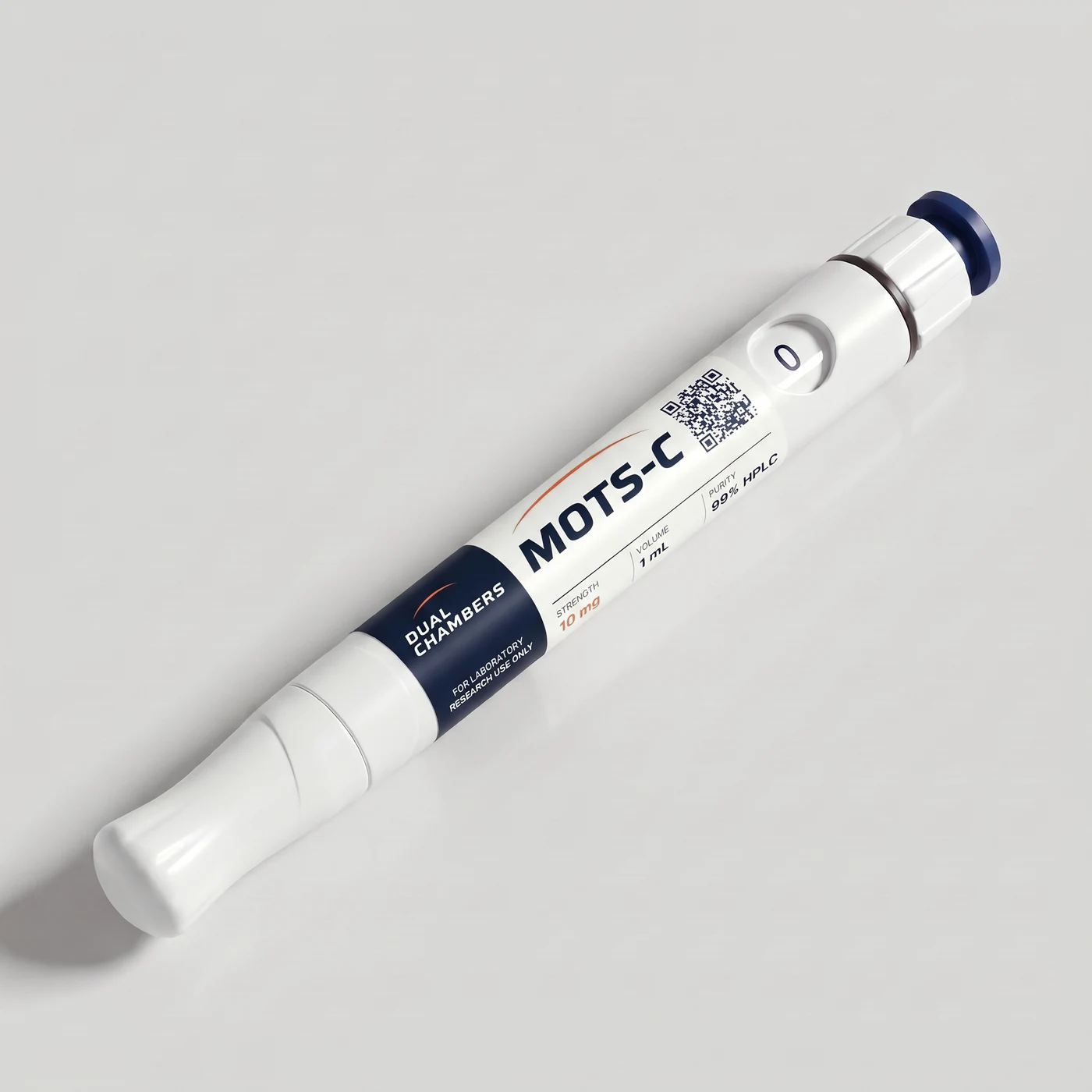
MOTS-c in a dual-chamber pen
Dual Chambers supplies MOTS-c 10 mg as a lyophilized peptide in a sealed dual-chamber pen, with sterile water in the second chamber, combined with a single twist to 1 mL. Keeping the peptide dry until the twist suits a sequence with residues that are sensitive to oxidation. Before the twist, the pen is stored dry, out of direct light and not frozen; after it, at 2 to 8 °C. Lab reports are published on the lab reports page as they are released.
MOTS-c is supplied as a research material only, for laboratory research use. It is not for human or veterinary use.
Dual Chambers products are not for human or veterinary use, and nothing in this article is an instruction for use in people or animals. Questions about a pen or a lab report: support@dualchambers.com.